
Reviews & Tutorials
AI Content Fact-Checking and Citation Management for Editorial Teams
AI can speed up research and drafting, but it cannot own factual responsibility. This guide shows editorial teams how to break claims apart, rank sources, track evidence, and review AI-assisted content before publication.
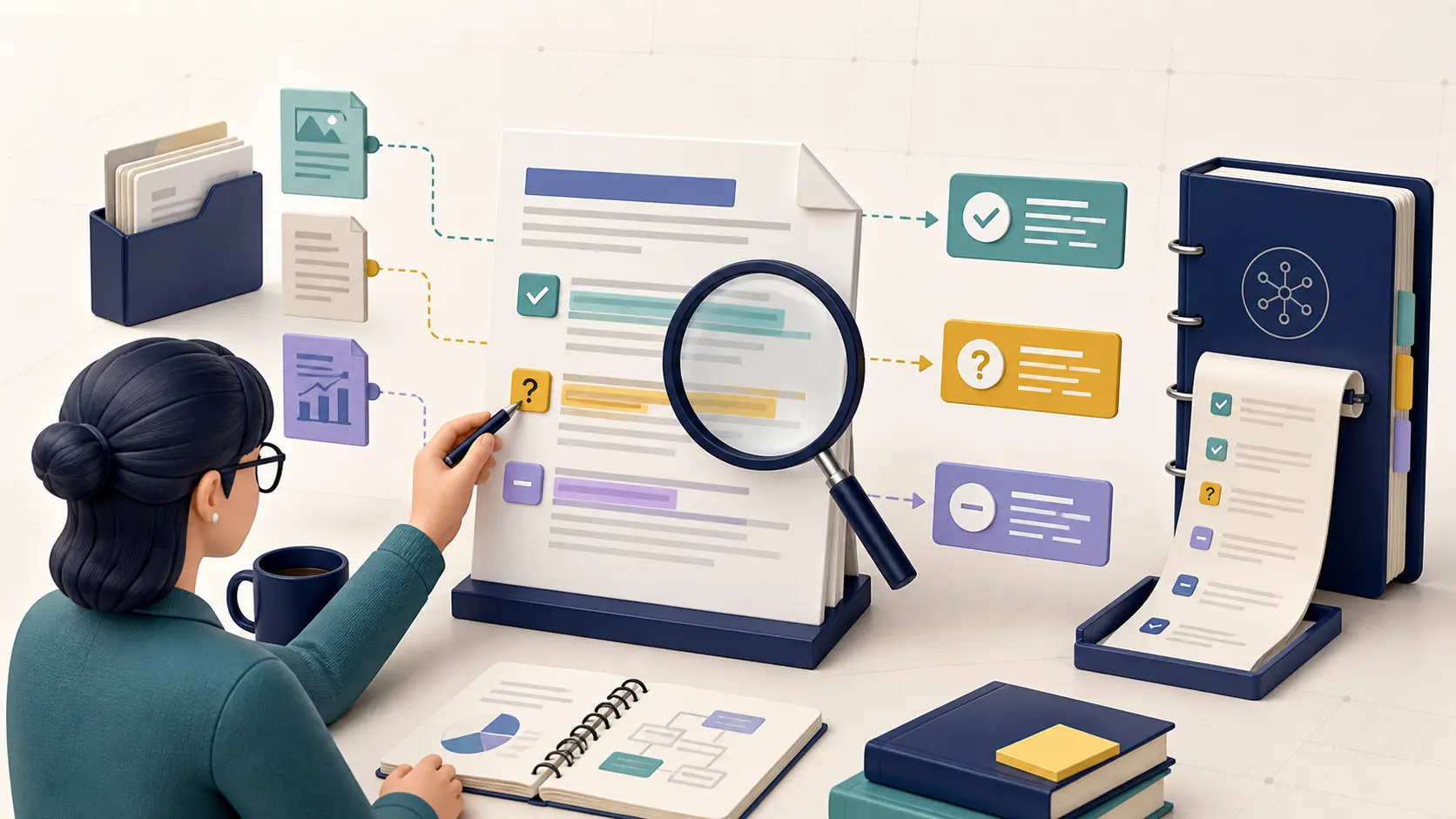
AI can make research, outlining, and drafting faster, but it cannot take factual responsibility for an editorial team. The most dangerous mistakes are often not obvious numbers. They are dates, conditions, product versions, citation scope, and conclusions that sound plausible but cannot be traced to an original source.
This guide is for content marketers, editors, SEO leads, and independent writers who use AI-assisted writing. The goal is not to turn every paragraph into an academic paper. The goal is to make important claims traceable, sources reviewable, and uncertainty visible.
1. Break the draft into checkable claims
Do not give an entire paragraph to an AI tool and ask whether it is true. Split it into independent claims, such as:
- a product released a feature on a specific date;
- a policy applies to a particular group of users;
- a study reached a conclusion under defined methods and samples;
- a price, limit, or API behavior is still current.
Every important claim should answer four questions: who said it, when, under what scope, and where is the original text? One citation does not automatically support every sentence in a paragraph.
2. Match source priority to the claim
Source priority should match the type of claim:
| Claim | Preferred source | What to check |
|---|---|---|
| Product behavior | Official docs, release notes, help center | Version and region |
| Law or policy | Government, regulator, or formal legal text | Original text versus commentary |
| Research finding | Paper or research institution | Sample, method, and date |
| Price or plan | Official pricing page, contract, or invoice | Retrieval date and conditions |
| User experience | Transparent test or interview | Do not turn one case into a general rule |
Search snippets, forum replies, and reposts can help you find a lead. They should not be the only evidence for a material claim.
Google Search Central’s people-first guidance emphasizes original analysis, clear authorship, verifiable facts, and transparency about how content was produced. Those are useful self-checks for AI-assisted editorial work: Creating Helpful, Reliable, People-First Content.
3. Keep an evidence table
For every article containing important facts, keep an evidence table with at least:
| Field | Purpose |
|---|---|
| Claim ID | Number each important claim |
| Draft claim | The exact wording planned for publication |
| Source URL | Direct link to the original page |
| Source type | Official, paper, test, or secondary source |
| Publication or update date | Evaluate freshness |
| Supported scope | What the source supports and what it does not |
| Review state | Open, verified, revise, or expired |
The value of citation management is not the number of links. It is how quickly an editor can answer, ‘Why did we write this sentence?’ If a link supports only half of a sentence, split the sentence or find a more precise source.
4. Decide what AI can and cannot do
AI is useful for:
- extracting claims that need verification;
- grouping sources by topic;
- finding conflicts among dates, numbers, names, and versions;
- generating research questions and an editorial checklist;
- checking whether links appear near the claims they support.
AI should not decide on its own:
- whether a source truly supports your conclusion;
- which of two conflicting sources is more authoritative;
- whether legal, medical, financial, or security advice is publishable;
- whether a missing source can be replaced with a plausible number.
An editor must open the original source and check its context and limitations. ‘The AI said it found this’ is not evidence.
5. Label uncertainty instead of hiding it
Not every piece of information can be verified to the same degree. Use explicit labels:
- Confirmed: a direct, current source matches the scope;
- Conditional: the source is valid only for a version, region, or sample;
- Conflicting public sources: show the disagreement instead of forcing one answer;
- Not yet verified: keep it as a lead, not a fact;
- Editorial judgment: label analysis, advice, or interpretation as such.
These labels do not weaken an article. They tell readers which parts they can act on and which parts need their own confirmation.
6. Run four reviews before publication
Claim review
Check facts in the title, description, body, tables, and FAQ. Pay special attention to numbers, dates, prices, versions, and absolute language.
Source review
Open every important link. Confirm that the page is reachable, the source identity is correct, and the original text supports the current wording. Do not rely on a search snippet.
Scope review
Check whether one case has been written as an industry trend, an old feature as a current capability, or a regional rule as a global rule.
Reader review
Ask someone unfamiliar with the project to read the article and its citations. Can they understand the conclusion, limitations, and next step without searching again? If not, the article needs more evidence or clearer wording.
7. Disclose meaningful AI assistance
Whether to disclose AI assistance should depend on what a reasonable reader would want to know about the production process. If AI only helped with spelling or structure, an internal record may be enough. If AI substantially contributed to research organization, drafting, or translation, explain the role in an editorial note when appropriate, while making clear that a human reviewed the sources and owns the final claims.
Disclosure does not transfer responsibility to the tool. The publisher remains responsible for authorship, citations, and conclusions.
FAQ
What if an AI-generated citation is broken?
Treat the claim as unverified. Find the original source again; if you cannot, remove the number or rewrite it as an explicit uncertainty.
Does every sentence need a citation?
No. Common knowledge, editorial structure, and clearly labeled analysis do not need a citation for every sentence. Material facts, disputed conclusions, numbers, dates, and product limitations should be cited close to the relevant wording.
When can a secondary source be used?
Use it when the primary source is unavailable or when the secondary source adds independent reporting or analysis. Label it as secondary so readers do not mistake it for an official statement.
Does an AI-assisted article need to be long?
No. Cover what readers need to complete the task. Accuracy, actionability, and traceable evidence matter more than adding paragraphs for a word count.
Conclusion
The advantage of an AI content team is not generating a first draft faster than everyone else. It is managing claims, evidence, scope, and uncertainty more reliably. Turn fact-checking into an evidence table and a pre-publication workflow, and AI becomes a controllable research assistant instead of a source of unreviewed assertions.