
Comparisons
Cursor vs GitHub Copilot vs Claude Code: A Practical Choice
Cursor, GitHub Copilot, and Claude Code represent three different AI coding workflows: an AI editor, a GitHub-native assistant, and a terminal agent.
Cursor vs GitHub Copilot vs Claude Code: A Practical Choice
These tools appear in the same rankings, but they represent different operating models. Cursor is an AI-centered editor. GitHub Copilot spans IDEs, GitHub, and the CLI. Claude Code behaves more like a terminal agent working inside a repository.
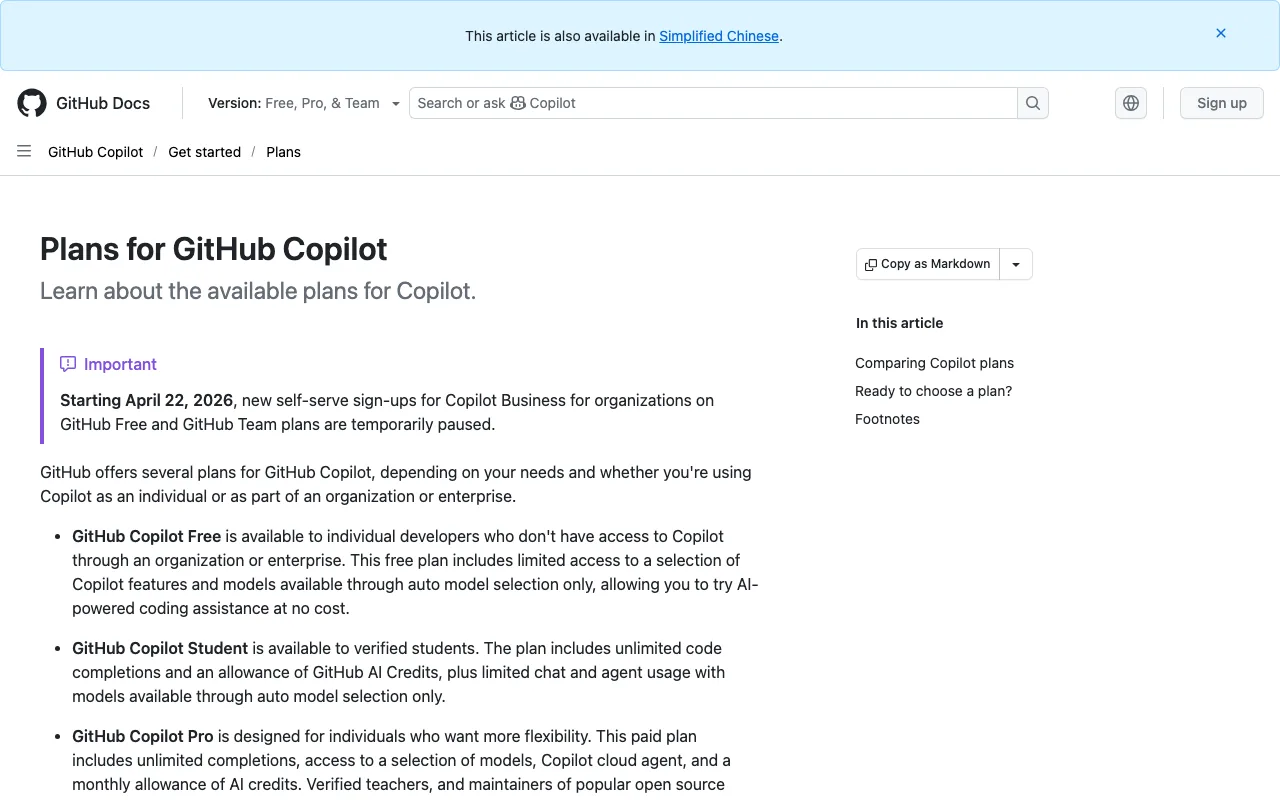 Source: GitHub Docs, captured July 12, 2026. Plans and usage allowances change; verify the live page before purchase.
Short answer: try Cursor when AI should sit inside every edit cycle. Start with Copilot when the organization already runs on GitHub. Test Claude Code when terminal-based, multi-file agent tasks are the priority.
Evaluation method
We use four repository jobs rather than a toy function: understanding an unfamiliar module, making a small cross-file change, diagnosing a failing test, and reviewing a pull request. Every task needs acceptance criteria and measured human review time.
| Dimension | Cursor | GitHub Copilot | Claude Code |
|---|---|---|---|
| Main surface | AI-native editor | IDE, GitHub, and CLI | Terminal and repository |
| Low-friction jobs | Completion, inline edits, editor agents | Completion, chat, PR and GitHub workflows | Multi-file analysis, commands, agent tasks |
| Team advantage | Shared rules and editor controls | GitHub policy, seats, and review integration | Composable terminal workflow |
| Adoption cost | Moving to a different editor | Lower for supported IDE users | Terminal and permission literacy |
| Cost driver | Plan plus model usage | Plan plus AI credits or premium usage | Claude plan or API usage boundaries |
Cursor: AI inside the edit loop
Cursor’s advantage is the relationship between editing, context, and agent actions. Developers making frequent changes across UI, business logic, and tests can reduce context switching.
The tradeoff is editor migration and usage management. Model selection affects consumption, while teams must inspect privacy enforcement, shared rules, and spend controls.
GitHub Copilot: strongest inside a GitHub organization
Copilot becomes more valuable as GitHub usage deepens. Beyond completion, organizations care about policy, seat management, code review, and repository context. Official plans now span several individual and organization tiers, and signup availability can change. Treat every price table as time-sensitive.
If the problem is standardized governance rather than maximum autonomy for one developer, Copilot often enters the existing stack with less friction.
Claude Code: terminal-first agent work
Claude Code is suited to repository-wide reading, planning changes, running tests, and explaining failures. That power makes permission design important. Start with limited directories, explicit command approval, and bounded turns. Broad unattended permissions should not be the default.
The three hidden costs
- Review cost: a change generated in ten minutes but reviewed for forty is not a ten-minute task.
- Context cost: indexing irrelevant files increases spend and can reduce quality.
- Rework cost: passing tests does not guarantee architectural, security, or product correctness.
A one-week pilot
- Day 1: use one repository, rule set, and task list.
- Days 2–3: complete two real, small issues with each tool.
- Day 4: diagnose the same real test failure and score the explanation.
- Day 5: compare delivery time, manual edits, test results, and permission incidents.
Keep code review, least privilege, secret scanning, and CI in place. No coding assistant should receive production credentials or merge unreviewed code.
Verdict
Cursor: individual developers and small teams that want editor-native agents.
GitHub Copilot: GitHub organizations that need a consistent path from IDE to pull request.
Claude Code: terminal-first developers handling repository-level tasks with careful permissions.
The most rational stack is usually one primary editor assistant and one on-demand terminal agent, not three overlapping subscriptions.
Official sources
Features and plans checked July 12, 2026.